What Is Chronic Inflammation, and How Does It Affect Long-Term Health?
Chronic Inflammation is a condition in which the body’s immune system is continuously activated over a long period and cannot return to its normal balance. As a result, the body remains in a constant state of inflammation, which can lead to certain abnormal symptoms such as chronic fatigue, joint pain, muscle pain, susceptibility to infection, and slower-than-normal recovery from illness or physical exertion.
If chronic inflammation is allowed to continue without appropriate care, it may damage cells and internal organs and become an underlying cause of several NCDs, such as cancer, cardiovascular disease, type 2 diabetes, autoimmune disease, Alzheimer’s disease, and depression.
Causes of Chronic Inflammation in Daily Life
Chronic inflammation in the body can arise from many factors, as follows:
- Insufficient sleep and poor sleep quality
- Accumulated stress
- Frequently eating foods that promote inflammation, such as foods high in sugar, trans fats, and processed foods
- Being overweight, having high blood lipids, or high blood sugar levels
- Lack of exercise and low levels of physical movement
- Smoking, drinking alcohol, or using addictive substances
- Regular exposure to toxins and chemicals, such as pollution, dust, smoke, and heavy metals
Warning Signs from the Body That Chronic Inflammation May Be Present
Chronic inflammation may not show clear symptoms in the early stages, so many people do not notice it or believe it is simply tiredness from daily life — until the symptoms become more severe and more frequent, for example:
- Tiring easily and feeling fatigued even with enough rest
- Waking up unrefreshed, not sleeping deeply or restfully
- Frequent muscle aches and joint pain with no known cause
- The body recovering slowly after heavy exertion or during a recuperation period
- Catching infections easily and having frequent fevers
- Frequent rashes, itching, allergies, or skin irritation
- Brain fog, poor concentration, and easily fluctuating mood
- Irregular digestion, bloating, and abnormal bowel movements
- Gaining weight easily, finding it hard to lose, or accumulating more fat
These symptoms cannot be used to diagnose chronic inflammation directly, but they are signals that should not be overlooked — especially in high-risk groups, such as people with underlying conditions, those who are overweight, or those with high blood lipids, high blood sugar, and high blood pressure. Such individuals should undergo a detailed health assessment to identify the true cause and plan appropriate care.
What Are NCDs, and Which Diseases Do They Include?
NCDs (Non-Communicable Diseases), or chronic non-communicable diseases, are a group of diseases that are not caused by infection and cannot be transmitted directly from person to person. They usually develop gradually over a long period, from several months to several years, arising from a combination of factors including inappropriate lifestyle behaviours as well as genetic factors, the environment, and increasing age. The concerning aspect of NCDs is that they often show no clear symptoms in the early stages, until complications occur or vital organs begin to function abnormally. The most commonly found groups of NCDs include:
- Cardiovascular diseases, such as high blood pressure, coronary artery disease, ischaemic heart disease, heart failure, and stroke
- Diabetes, particularly type 2 diabetes
- Central obesity and Metabolic Syndrome, which are significant factors that increase the risk of developing other NCDs
- Certain cancers, such as lung cancer, breast cancer, stomach cancer, colorectal cancer, liver cancer, and cervical cancer
- Chronic respiratory diseases, such as chronic obstructive pulmonary disease (COPD), asthma, and emphysema
- Dementia and Alzheimer’s disease
What Is EBOO PLUS Therapy, and How Does It Help Restore Chronic Inflammation in the Body?
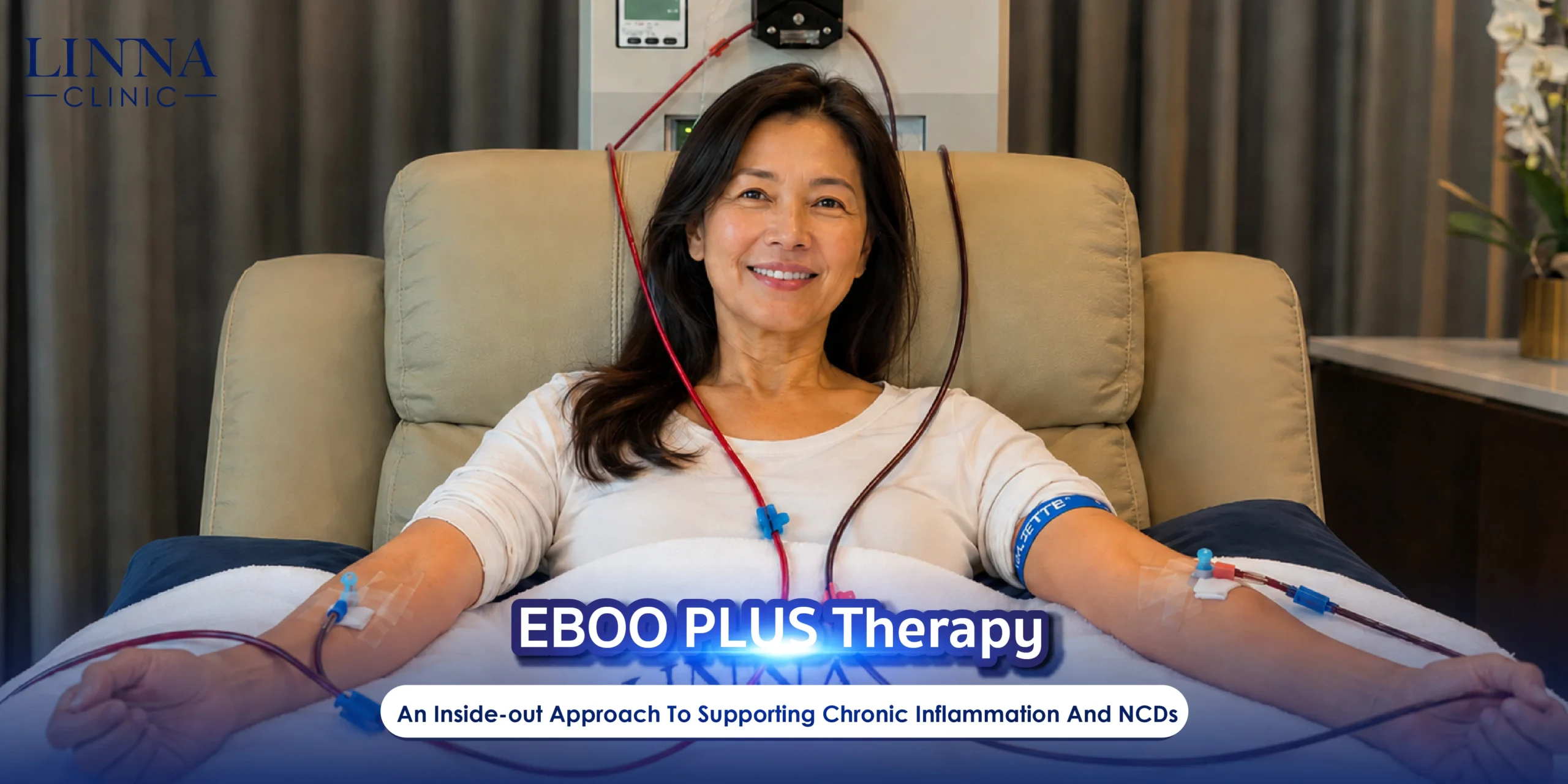
EBOO PLUS Therapy, or Extracorporeal Blood Oxygenation and Ozonation, is a health care technique in the Blood Detox group that filters and cleanses the blood using a special filter together with the addition of medical oxygen and ozone at an appropriate concentration, before continuously returning the blood to the body. This process helps care for the circulatory system so that it works better, and helps restore chronic inflammation through the body’s natural mechanisms in several dimensions.
- Helps support blood circulation. The circulatory system is the main route for delivering oxygen and nutrients to cells. When blood circulates well, it helps cells receive the substances necessary for the processes of restoration and self-repair.
- Helps support the delivery of oxygen to tissues and cells in the body. Oxygen plays an important role in energy production within cells, particularly in the Mitochondria, which are the cells’ main energy source. Appropriately supporting oxygen delivery therefore helps add energy to cells and supports the body’s recovery.
- Helps rebalance the body’s immune system by stimulating the response of white blood cells, including the release of certain Cytokines, which are involved in the inflammatory process and the functioning of the body’s immune system.
How Can EBOO PLUS Therapy Help with NCDs?
EBOO PLUS Therapy may help support the health care of people who are at risk of, or already within, the NCDs group, by focusing on improving factors related to the development of these diseases — such as chronic inflammation, Oxidative Stress, and abnormalities of the circulatory system — through a closed-system blood cleansing process combined with the addition of medical oxygen and ozone at an appropriate level, in order to help support blood circulation, the delivery of oxygen and essential substances to the tissues, and to help rebalance the body.
According to a literature review in the field of bone, muscle, and joint disorders in 2024, Ozone Therapy may help stimulate the body’s natural antioxidant system, reduce the production of certain inflammatory mediators, and help rebalance Oxidative Stress, which is a factor that may be related to the development of NCDs. In addition, it helps support blood circulation and improve the delivery of oxygen to various tissues (Jeyaraman et al., 2024).
This is consistent with a 2025 literature review, which compiled data from several clinical studies and found that Ozone Therapy may help reduce Oxidative Stress and help support the body’s antioxidant system in certain groups of patients (Alimohammadi et al., 2025).
In addition, there was a controlled study in 28 patients with Peripheral Artery Disease, which found that the group receiving EBOO showed improvement in several aspects of the disease — including the healing of skin wounds, pain, itching, the sensation of heavy legs, and overall quality of life — when compared with the group receiving intravenous prostacyclin. However, the researchers did not find a clear difference in blood circulation in the arteries of the legs, so it may be presumed that the improved outcomes could also be related to other mechanisms (Di Paolo et al., 2005).
Nevertheless, it should be understood that EBOO PLUS Therapy is only a process to help restore the functioning of the body. It is not a direct treatment for NCDs and cannot replace primary medical treatment. People with chronic inflammation, or who have been diagnosed with an NCD, should consult a doctor to assess their risks and plan an individually tailored restorative programme.
How Many EBOO PLUS Therapy Sessions Should Be Done to Care for Chronic Inflammation Appropriately?
In general, doctors may recommend EBOO PLUS Therapy approximately 1 session per week, performed continuously for 4–5 sessions, in order to fully support the body’s restoration and the care of chronic inflammation. After that, repeating every 3–4 months may be considered, or as appropriate for each individual case. However, the results obtained may differ from person to person, depending on many factors such as baseline health, the level of inflammation, lifestyle behaviours, and self-care after the treatment.
How Do You Feel After the Treatment?
The results after EBOO PLUS Therapy may differ from person to person. Some people may begin to feel a change after the first session, while others need to continue for several sessions before clear results begin to appear. Those receiving the service may notice the following changes afterwards:
- Feeling refreshed, energised, and lighter in the body
- Breathing more freely
- Sleeping well, with reduced fatigue
- A clearer mind with better focus and concentration
- The body recovering better
- Reduced aching and tightness in various parts of the body
Preparation Before EBOO PLUS Therapy
Before undergoing EBOO PLUS Therapy, the body should be properly prepared so that the process is appropriate and safe. The recommendations are as follows:
- Undergo a health assessment with a doctor for history taking, physical examination, and consideration of individual suitability before receiving the therapy
- Inform the doctor in detail about any underlying conditions, treatment history, medications taken regularly, as well as any history of drug or substance allergies
- Rest sufficiently, sleeping at least 6–8 hours, and avoid strenuous activities before the treatment
- Drink enough clean water to help the circulatory system work better
- Avoid drinking alcohol for at least 24–48 hours before the treatment
- Stop taking Vitamin C for 1 day before the treatment to prevent a reduction in the effectiveness of EBOO Therapy; afterwards, Vitamin C can be resumed as usual once 24 hours have passed
- If you have a fever, fatigue, or an acute infection, the appointment should be postponed until you have fully recovered
Should It Be Combined with Vitamin Drips, Exosome IV, or Stem Cells Therapy? How Do You Choose?
- EBOO PLUS Therapy can be planned together with other health restoration programmes, such as Vitamin Drips, Exosome IV, or Stem Cells, depending on each individual’s baseline health and restoration goals, as each process has a different purpose.
- Vitamin Drips deliver vitamins, minerals, and essential nutrients into the vein, allowing the body to receive nutrients into the bloodstream quickly. They are suitable for people who rest too little, feel fatigued, do not eat enough, or have a condition that requires supplementation of certain nutrients according to a doctor’s assessment.
- Exosome IV is a technique of dripping exosomes directly into the body through the vein in order to help stimulate the processes of cellular repair and restoration, reduce inflammation, and help increase energy levels. It is suitable for people with injuries, chronic inflammation, or those who wish to restore their health after illness or after surgery.
- Stem Cells Therapy is a therapeutic process using stem cells extracted from the human body to help repair damaged tissues and cells so that they function better. It is suitable for people who want holistic health restoration, those with age-related conditions, or whose bodies are deteriorating with age.
- After EBOO PLUS Therapy — which helps care for the circulatory system, increase oxygen to the cells, and reduce part of the waste burden in the bloodstream — the doctor may consider Vitamin Drips to replenish the vitamins and nutrients the body needs, or Exosome IV and Stem Cells in cases where care at the cellular level is desired. The doctor will assess and plan the sequence of restoration, including the appropriate interval between each programme, so that it aligns with each individual’s baseline health and health care goals.
Summary
Chronic inflammation is a silent threat that may affect long-term health, and it is one of the factors that may be related to the risk of many groups of NCDs, such as cardiovascular disease, diabetes, obesity, chronic respiratory disease, and other chronic conditions. Health care should therefore begin with reducing the factors that trigger inflammation, adjusting lifestyle behaviours, resting sufficiently, choosing appropriate foods, exercising regularly, and having regular health check-ups.
EBOO PLUS Therapy is another medical innovation that helps support the body’s restoration from within, by helping care for the circulatory system, increasing oxygen to the cells, reducing part of the waste burden in the bloodstream, and helping to rebalance the body. It is suitable for people with chronic fatigue, slow recovery, risk factors for accumulated inflammation, or those who wish to take a preventive approach to health care for a long life of good quality.
If you are interested in caring for your health from within and reducing the risk of chronic inflammation and NCDs, you can consult the medical team at LINNA Clinic for a detailed health assessment and an individually tailored restoration plan with EBOO PLUS Therapy. Contact LINNA Clinic at 063-609-8888, WhatsApp +66 919799554, or LINE: @linnaclinic.
References
- Jeyaraman, M., Jeyaraman, N., Ramasubramanian, S., Balaji, S., Nallakumarasamy, A., Patro, B. P., & Migliorini, F. (2024). Ozone therapy in musculoskeletal medicine: A comprehensive review. European Journal of Medical Research, 29(1), 398. https://doi.org/10.1186/s40001-024-01976-4
- Alimohammadi, M., Khoshnazar, S. M., Khajehpour, H., Izadi, M., Einollahi, B., & Hushmandi, K. (2025). Effect of ozone therapy on oxidative stress indices in chronic inflammatory diseases: A systematic review and meta-analysis of randomized clinical trials. Advances in Redox Research, 17, https://doi.org/10.1016/j.arres.2025.100143
- Di Paolo, N., Bocci, V., Salvo, D. P., Palasciano, G., Biagioli, M., Meini, S., Galli, F., Ciari, I., Maccari, F., Cappelletti, F., Di Paolo, M., & Gaggiotti, E. (2005). Extracorporeal blood oxygenation and ozonation (EBOO): A controlled trial in patients with peripheral artery disease. The International Journal of Artificial Organs, 28(10), 1039–1050. https://doi.org/10.1177/039139880502801012
This article has been prepared and reviewed by the LINNA Clinic medical team.
Related programs

EBOO Therapy (1 Session)

Double Filtration Plasmapheresis (DFPP)
Interested in this program or need personalised advice?
The LINNA Clinic team is ready to help you choose the program that suits you best.