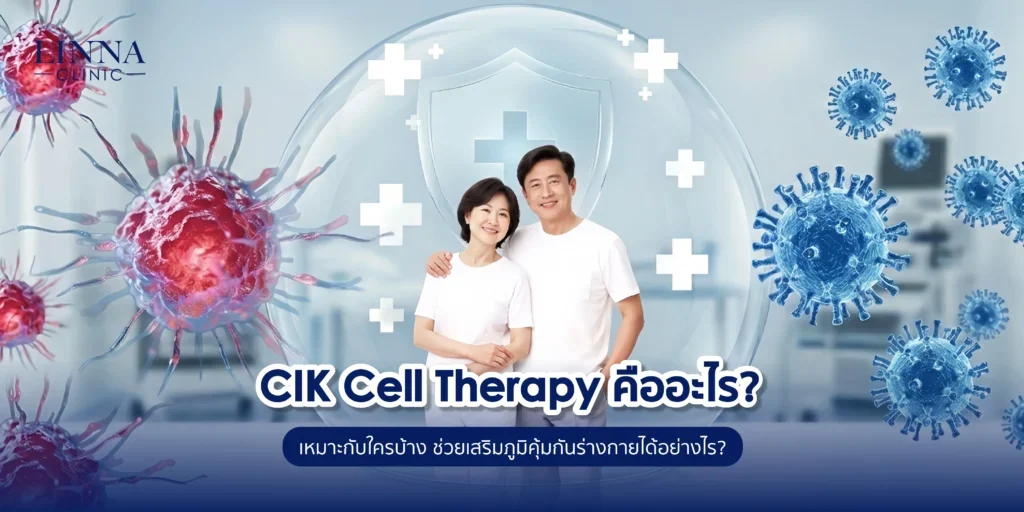
The immune system (Immune system) serves as a vital defense barrier that monitors and protects the body from external threats while detecting abnormalities within the body, such as damaged cells, tumors, and cancer cells, helping maintain overall health. However, aging and everyday factors—including accumulated stress, insufficient rest, pollution, exposure to chemicals, and certain medical conditions—may weaken the immune system, increase susceptibility to infections, slow recovery, and worsen disease symptoms. For this reason, therapies intended to restore immune-system function have gained increasing attention, particularly CIK Cell Therapy. This therapy involves collecting the patient's white blood cells, culturing them to increase their quantity and functional capacity, and returning them to the body to safely support the natural immune response. What is CIK Cell Therapy? How does it work? Who is it suitable for, and what should you know before undergoing treatment? LINNA Clinic answers these questions in this article.
 What Is CIK Cell Therapy and How Can It Support the Immune System?
What Is CIK Cell Therapy?
CIK Cell Therapy is a form of therapy that uses the patient's own immune cells. Peripheral blood mononuclear cells (PBMCs), which serve as the starting material for producing Cytokine-Induced Killer Cells (CIK Cells), are collected from the patient and stimulated and cultured in a laboratory. Certain stimulating agents—including interferon-gamma (IFN-γ), anti-CD3 antibody, and interleukin-2 (IL-2)—are used to increase the cells' quantity and enhance their functional capacity. Producing healthy cells that are ready for use generally takes approximately 14–21 days. The prepared CIK Cells are then returned to the body through an intravenous infusion.
What Are CIK Cells and How Do They Work?
CIK Cells, or Cytokine-Induced Killer Cells, are a group of immune cells produced by separating PBMC white blood cells from the patient and culturing and stimulating them in a laboratory. This increases their quantity and functional capacity, producing CIK Cells that combine characteristics of Natural Killer Cells (NK Cells) and T Cells. They can therefore enhance the body's ability to detect and respond to abnormal cells.
CIK Cells combine the capabilities of these two immune mechanisms. Their primary role is to monitor for and identify abnormal cells, including damaged cells, infected cells, and cancer cells. When a target is detected, CIK Cells bind to it and release substances such as perforin and granzyme to destroy it immediately without first requiring specific cellular identification or memory.
They also coordinate immune responses by releasing cytokines such as interferon-gamma (IFN-γ), interleukin-2 (IL-2), and interleukin-4 (IL-4). These cytokines stimulate responses from other immune cells and support the overall functional balance of the immune system.
What Can CIK Cell Therapy Help With?
- Increases the quantity and efficiency of immune cells capable of rapidly and accurately detecting and destroying abnormal cells without first requiring cellular identification or memory. By combining the functions of NK Cells and T Cells, it may help control disease severity and reduce the likelihood of recurrence.
- May help control cancer because CIK Cells can directly respond to cells undergoing mutation or cancer cells.
- Helps stimulate other immune cells and may reduce inflammation through the release of anti-inflammatory cytokines.
- Supports efficient immune-system balance and may help prevent abnormal immune function.
- Supports physical recovery and helps reduce immune exhaustion.
Who Is CIK Cell Therapy Suitable For?
- People with a family history associated with certain chronic diseases who are seeking an approach that may help stimulate immune-system function.
- People with certain cancers or those recovering after cancer treatment.
- People experiencing physical exhaustion or weakened immunity associated with aging, stress, or certain lifestyle behaviors.
CIK Cell Therapy is only a supportive therapy intended to promote immune-system function under a physician's discretion. Results may vary between individuals depending on age, health status, disease stage, and self-care. CIK Cell Therapy cannot replace standard medical treatment.
Who Is CIK Cell Therapy Not Suitable For?
- People with an acute infection or symptoms such as fever, cough, sore throat, or phlegm should wait until their condition has returned to normal.
- People with certain severe immune-system disorders, such as autoimmune disease.
- People with uncontrolled underlying conditions, such as severe heart failure or kidney disease.
- Cancer patients currently receiving high-dose chemotherapy or who have low blood-cell counts.
- People currently taking immunosuppressive medication.
- People with certain severe blood disorders or abnormal bleeding tendencies.
- Pregnant or breastfeeding women.
Is CIK Cell Therapy Safe?
CIK Cell Therapy uses the patient's own white blood cells, which are cultured in a standardized laboratory. Case-study findings have reported that the resulting CIK Cells showed no detectable contamination from toxins, bacteria, or fungi. Because the likelihood of an allergic reaction or cellular rejection is low, it is considered a procedure with a favorable safety profile that is not harmful to the body.
However, CIK Cell Therapy must be performed under the supervision of an experienced physician and only in a medical facility or clinic with strict quality-control standards.
Possible Side Effects After CIK Cell Therapy
After CIK Cell Therapy, patients may experience chills, a mild fever, or slight fatigue. These symptoms commonly result from the body's immune response and generally improve within 1–3 days. If abnormal symptoms occur or symptoms do not improve, consult a physician immediately.
How Is CIK Cell Therapy Different from NK Cell Therapy?
CIK Cell Therapy and NK Cell Therapy are both forms of Immune Cell Therapy, but they differ in the cells used and their mechanisms of action.
NK Cell Therapy uses Natural Killer Cells, which are white blood cells belonging to the innate immune system. These cells are cultured and stimulated outside the body before being returned to increase the number of NK Cells and enhance their ability to rapidly detect and destroy target cells without requiring specific antigen recognition.
CIK Cell Therapy uses PBMC white blood cells that are cultured and stimulated with certain substances to develop into CIK Cells. These cells combine characteristics of NK Cells and T Cells and can detect and destroy abnormal cells through multiple mechanisms, including antigen-independent responses and specific mechanisms associated with T Cells.
The appropriate approach should be selected in consultation with an experienced physician according to the individual's physical condition and therapeutic objectives.
How Is CIK Cell Therapy Different from Stem Cell Therapy?
CIK Cell Therapy primarily focuses on supporting immune-system function. The patient's PBMC white blood cells are cultured and stimulated with certain substances in a laboratory to develop into CIK Cells. These cells work through two mechanisms—those of NK Cells and T Cells—to detect and eliminate abnormal cells, including deteriorated, infected, and cancer cells.
Stem Cell Therapy focuses on repairing and restoring deteriorated or damaged cells so they may function more normally. Stem cells obtained from sources such as umbilical cords, adipose tissue, blood, bone marrow, and teeth are isolated and cultured before being administered intravenously.
This approach relies on the ability of stem cells to divide and develop into certain specialized cells, such as bone, muscle, and nerve cells and other tissues. Stem cells may also secrete biomolecules that help reduce inflammation and slow bodily degeneration.
CIK Cell Therapy Procedure
- Consult a physician for a detailed health assessment. The physician will perform blood tests and any additional evaluations appropriate for the individual case.
- Blood is drawn from the patient.
- The blood is processed to isolate Peripheral Blood Mononuclear Cells (PBMCs), the white blood cells used as the starting material for producing CIK Cells.
- The PBMCs are cultured and enhanced with stimulating agents in a laboratory. This process takes approximately 14–21 days to produce a sufficient quantity of functional CIK Cells.
- The prepared CIK Cells are returned to the patient intravenously at an appropriate volume and infusion rate.
- The patient is monitored after therapy and may then return home without remaining at the clinic for recovery.
The complete CIK Cell Therapy process may take several weeks. Patients should plan sufficient time, attend all scheduled appointments, and avoid unnecessary postponements.
Preparation Before Therapy
- Consult a physician for a health assessment, blood testing, and physical examination as advised. Inform the physician in detail about underlying conditions, medications, and supplements used regularly.
- Avoid alcohol and smoking for at least 3–7 days before therapy.
- Discontinue chemotherapy, immunosuppressive medication, and certain antimicrobial medications only as instructed by the physician.
- Sleep for at least 7–8 hours and avoid exhausting activities, particularly before blood collection.
- Drink 1.5–2 liters of clean water.
- Ensure that the body is in a normal condition without infection or inflammation, such as fever, cough, diarrhea, or an inflamed wound. Women who are menstruating should inform the physician so the timing of blood-cell collection can be assessed and postponed if appropriate.
Self-Care After CIK Cell Therapy
- Get sufficient rest to support full recovery.
- Drink at least 1.5–2 liters of clean water per day.
- Avoid alcohol and smoking for at least 3–7 days after therapy, and regularly consume a nutritious, balanced diet containing all five food groups.
- Avoid strenuous activity or activities that cause exhaustion during the first 1–2 days.
- Attend scheduled follow-up appointments.
- If abnormalities such as fever, chills, or unusually severe fatigue occur, consult a physician immediately.
Summary
CIK Cell Therapy is an approach to health care and internal immune support using CIK Cells derived from the patient's PBMC white blood cells. The cells are cultured to increase their quantity and functional capacity before being returned intravenously to support the natural immune response.
It may be suitable for people seeking holistic health care, those with chronic diseases or cancer, and those experiencing immune exhaustion. However, CIK Cell Therapy is not a treatment or cure for disease and cannot replace standard medical care.
The decision to undergo therapy should be based on a detailed health assessment and the judgment of an experienced physician. Results vary according to age, disease stage, physical condition, and individual self-care.
If you are seeking an option to support and restore your health from within, contact LINNA Clinic for a personalized health plan. Every step is supervised by the clinic's medical team, who will answer your questions and provide complete information before you decide.
Contact: 063-609-8888 WhatsApp: +66 919799554 LINE: @linnaclinic
This article has been prepared and reviewed by the LINNA Clinic medical team.
Interested in this program or need personalised advice?
The LINNA Clinic team is ready to help you choose the program that suits you best.