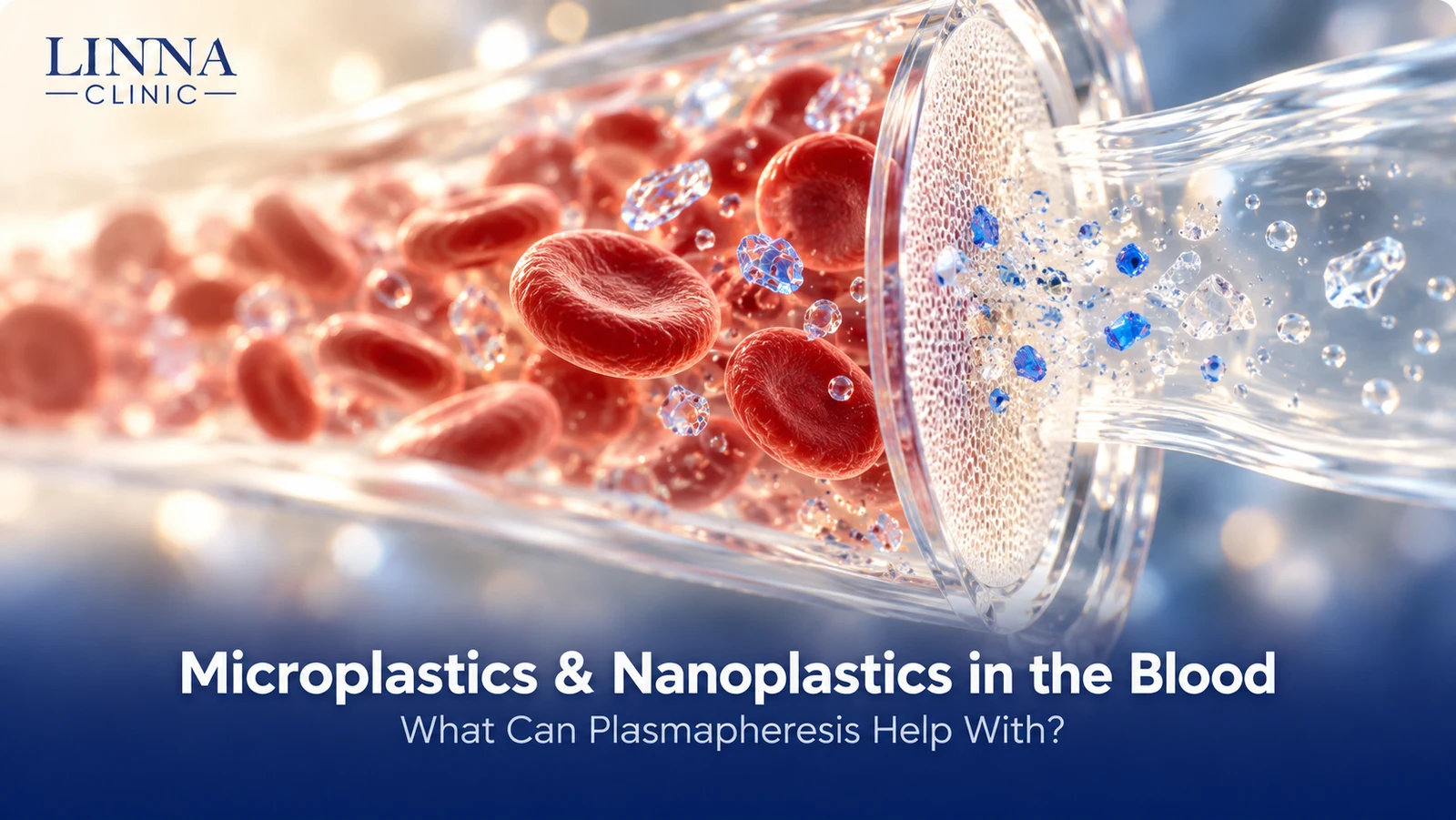
Plasmapheresis is a medical procedure that has attracted increasing interest for its ability to help filter and reduce certain unwanted substances circulating in the bloodstream, such as lipids, abnormal antibodies, inflammatory substances, and certain substances involved in disease processes. Some research also suggests that plasmapheresis may help reduce microplastics and nanoplastics—tiny particles that can enter the body through food, water, and the surrounding environment and have been detected in human blood and certain tissues.
For those interested in preventive health and supporting the body’s recovery from within, this raises the question: Can plasmapheresis really reduce microplastics and nanoplastics in the blood? How much scientific evidence currently supports this possibility? In this article, LINNA Clinic explores the answers and the information you should know to help you make an informed decision.
المقال الكامل متاح باللغة التايلاندية.
What Are Microplastics and Nanoplastics?
Microplastics and nanoplastics, collectively referred to as MNPs, are small plastic particles that may be manufactured at a small size or formed through the fragmentation and degradation of larger plastic products in the environment. In general, microplastics refer to plastic particles ranging from approximately 1 micrometer (µm) to less than 5 millimeters, while nanoplastics refer to particles smaller than 1 micrometer. However, the size criteria for nanoplastics may vary depending on the definitions used by individual studies and organizations.
Because of their extremely small size and physical properties, some MNPs can cross the body’s biological barriers, enter the bloodstream, and spread to different tissues. Plastic particles or components have been reported in various parts of the human body, including the gastrointestinal tract, lung tissue, placenta, and blood vessel walls. Researchers have also investigated their potential to cross the blood–brain barrier, an important barrier between the bloodstream and the central nervous system.
How Do Microplastics and Nanoplastics Enter the Bloodstream?
Humans can be exposed to MNPs through several routes, particularly by consuming contaminated food and water and inhaling tiny airborne plastic particles. Some very small particles may cross the biological barriers of the digestive and respiratory systems before entering the lymphatic system and bloodstream. They may then spread to tissues or organs throughout the body.
A 2022 study by Leslie and colleagues analyzed blood samples from 22 healthy volunteers and detected several types of plastic polymer components, including polyethylene terephthalate (PET), polyethylene (PE), styrene polymers, and poly(methyl methacrylate) (PMMA). The mean total concentration of plastic detected was approximately 1.6 µg/mL. This study provides important evidence supporting the possibility that components of plastic particles can enter the human bloodstream. However, it did not directly identify the routes through which the particles entered the body, and its sample size was small. Further research is therefore needed (Leslie et al., 2022).
How Harmful Are Microplastics and Nanoplastics? How Do They Affect the Body?
Although current evidence does not yet clearly establish the effects of MNPs on human health, several studies have identified mechanisms that may be associated with various health effects, such as:
-
Triggering oxidative stress: Plastic particles may increase the production of reactive oxygen species (ROS), disrupting the balance within cells and potentially damaging proteins, lipids, cell membranes, and DNA. If this continues over time, it may contribute to inflammation, blood vessel dysfunction, and an increased risk of certain chronic diseases.
-
Potentially triggering inflammation: When plastic particles enter the body, the immune system may recognize them as foreign substances. This can activate immune cells and stimulate the release of substances involved in inflammation, potentially increasing inflammation within the body.
-
Disrupting cellular and mitochondrial function: Cell-based research has found that certain MNPs may interfere with mitochondria, which play an important role in producing cellular energy. These effects have been associated with reduced ATP production and increased ROS, potentially leading to cell damage and cell death. However, most evidence comes from laboratory studies, and further human research is needed (Li et al., 2023).
-
Potential associations with cardiovascular health: A study involving 304 patients undergoing carotid endarterectomy, with 257 completing follow-up, detected certain MNPs in arterial plaques. Over a mean follow-up period of approximately 33.7 months, patients whose plaques contained plastic particles had a higher incidence of heart attack, stroke, or death from any cause than those whose plaques did not. However, this was an observational study. It demonstrated an association between the presence of small plastic particles in plaques and the risk of these outcomes but could not confirm a direct causal relationship (Marfella et al., 2024).
Ways to Reduce Exposure to Microplastics and Nanoplastics
Although reducing exposure to MNPs can be challenging because these particles are present in food, water, and air, exposure can be minimized through measures such as:
-
Avoid heating food or eating hot food in plastic containers that are not designed for high temperatures.
-
Reduce the use of disposable plastic or foam containers. Choose glass, stainless steel, or ceramic containers for food and beverages to minimize unnecessary contact with plastic.
-
Avoid using plastic bottles or containers that are deteriorating, cracked, scratched, or have been exposed to high temperatures for prolonged periods.
-
Choose cooking utensils carefully. Avoid plastic materials and use stainless steel, glass, wood, or ceramic alternatives.
-
Clean your home regularly to reduce dust, including plastic fibers from textiles, furniture, and other materials.
-
Thoroughly wash ingredients, vegetables, and fruit before eating.
Can the Body Eliminate Microplastics and Nanoplastics Naturally?
The human body has mechanisms that can eliminate some MNPs through feces. Microplastics have also been detected in human urine. However, the ability to eliminate plastic particles depends on several factors, including their size, shape, polymer type, surface properties, and location within the body. These factors may make nanoplastics more difficult to eliminate than larger microplastics.
Although the body can naturally excrete some plastic particles, there is currently no clear evidence that it can completely eliminate MNPs remaining in the bloodstream or tissues. This has led to growing interest in medical approaches that filter and separate certain substances from the blood. One such approach is plasmapheresis. Particles with characteristics consistent with microplastics and nanoplastics have been reported in material separated during the procedure, and preliminary human data suggest that blood microplastic levels may decrease afterward.
However, this procedure is only a supplementary approach to help separate and reduce certain unwanted substances circulating in the bloodstream. It is not a method for directly eliminating MNPs or treating their effects. Further research is needed to evaluate its effectiveness, safety, and long-term health effects.
What Is Plasmapheresis, and How Does It Work?
Plasmapheresis is a procedure that separates plasma from blood cells using a system outside the body to help isolate and reduce certain unwanted substances circulating in the bloodstream. Several techniques are used in medical practice. These include therapeutic plasma exchange (TPE), which removes the patient’s plasma and replaces it with an appropriate replacement fluid, and double filtration plasmapheresis (DFPP), which uses a two-stage plasma filtration system. DFPP allows more selective separation of certain substances from plasma, reduces the loss of important plasma components, and requires less replacement fluid. Its main steps are:
-
Separating plasma from blood cells: Blood enters the machine and passes through the first filter, which separates plasma from blood components, including red blood cells, white blood cells, and platelets.
-
Filtering certain substances from the plasma: The separated plasma passes through a second filter designed to separate molecules according to size, helping reduce certain substances targeted for removal.
-
Returning blood components to the body: The filtered plasma and blood cells are returned to the circulation.
A key feature of DFPP is its ability to selectively filter certain large molecules from plasma while retaining more of some components the body still needs than conventional plasma exchange, which removes the plasma as a whole and requires replacement fluid.
Can Plasmapheresis (DFPP) Really Reduce Microplastics and Nanoplastics in the Blood?
Emerging human research suggests that double filtration plasmapheresis (DFPP), a two-stage plasma filtration procedure, may have the potential to reduce some MNPs circulating in the bloodstream. However, research in this area remains at an early stage, and larger studies with long-term follow-up are needed.
In a 2022 study, Scholkmann and Gatti examined material filtered from plasma during DFPP using FE-SEM/EDX and found particles ranging from nanometers to micrometers in size in the separated material. These findings provide preliminary evidence that small particles can be found in material separated from plasma during DFPP. However, the study did not specifically confirm that all detected particles were microplastics or nanoplastics (Scholkmann & Gatti, 2022).
In 2025, Bornstein and colleagues analyzed material separated from plasma during double-filtration therapeutic apheresis (INUSpheresis) in 21 patients using ATR-FT-IR. They detected substances with characteristics consistent with several polymers, including polyamide-6 and polyurethane. These findings support the possibility that some particles resembling microplastics and nanoplastics may be filtered and separated from plasma. However, the study did not measure blood plastic particle levels before and after treatment, so it could not determine the extent to which DFPP reduced microplastics and nanoplastics in the bloodstream (Bornstein et al., 2025).
In 2026, Bornstein and colleagues investigated changes in blood microplastics and nanoplastics before and after DFPP using several analytical methods. Polyethylene (PE) decreased in all four participants assessed using Py-GC-MS, while polyvinyl chloride (PVC) decreased in three of the four. In another four participants assessed using Nile Red staining combined with flow cytometry, the number of detectable particles decreased by an average of approximately 70% after DFPP. However, this method could not specifically confirm that all detected particles were microplastics or nanoplastics. The sample size was also small, and the different polymers did not all show the same pattern of reduction. It is therefore not yet possible to conclude that DFPP reduces all types of plastic to the same extent or completely removes plastic particles from the body (Bornstein et al., 2026).
Overall, human data support the possibility that plasmapheresis (DFPP) may help reduce some microplastics circulating in the bloodstream. However, it remains unclear how long these effects last or whether the procedure can also reduce plastic particles distributed or accumulated in other tissues and organs. Evidence concerning nanoplastics remains relatively limited because these particles are extremely small and difficult to measure.
Anyone interested in plasmapheresis (DFPP) should understand that its effectiveness in reducing MNPs and its long-term safety for this purpose remain under investigation. It should therefore be considered a health-supporting approach rather than a treatment for disease. A physician should assess the indications and develop an appropriate, individualized treatment plan.
What You Should Know About Using Plasmapheresis (DFPP) to Help Reduce Microplastics and Nanoplastics
Although evidence is beginning to emerge regarding the potential of plasmapheresis (DFPP) to help reduce plastic particles circulating in the bloodstream, several considerations and limitations should be taken into account:
-
There are currently no standard medical guidelines recommending plasmapheresis for the general population primarily to remove microplastics and nanoplastics from the bloodstream.
-
Evidence concerning nanoplastics remains relatively limited, particularly regarding their measurement and the assessment of how effectively they can be removed from the body, because these particles are extremely small.
-
A reduction in blood plastic particle levels does not mean that all plastic particles have been eliminated from the body, as plasmapheresis mainly acts on substances circulating in the blood. However, some substances accumulated in tissues throughout the body may later move back into the bloodstream and could potentially be removed during subsequent sessions. Plasmapheresis (DFPP) may therefore offer another approach to reducing certain unwanted substances circulating in the body.
-
The duration of the results remains unclear. Further research is needed to determine how long blood plastic particle levels remain reduced after plasmapheresis and whether they may rise again later. Results may vary between individuals depending on daily habits, lifestyle, and environmental exposures.
-
Some temporary side effects may occur after plasmapheresis, such as low blood pressure. The clinic regularly measures blood pressure and monitors symptoms. Low blood sugar may occur because metabolism is stimulated during the procedure. Patients are advised to eat before treatment, and the clinic keeps glucose available if needed. Bruising or swelling may occur at the needle insertion site, and some patients may feel tired from lying in the same position for an extended period. These symptoms generally improve gradually with adequate rest and care according to the physician’s advice.
Conclusion
Microplastics and nanoplastics (MNPs) are environmental pollutants that can enter the body through several routes, including food, beverages, inhalation, and contact. Research has detected plastic particles or components in human blood and various tissues, with findings suggesting associations with inflammation, cellular function, and cardiovascular health. However, much of the evidence remains under investigation, and a clear causal relationship with disease has not yet been established.
For plasmapheresis (DFPP), preliminary findings have identified plastic particles in material separated during blood filtration, and human studies have reported reduced blood microplastic levels after treatment. However, the research has several limitations. It is not yet possible to conclude that plasmapheresis can completely eliminate microplastics and nanoplastics from the body or determine its long-term effects on health. Larger studies and further follow-up are needed.
To support safety and reduce risks, minimizing unnecessary exposure to plastic in daily life remains a fundamental part of health care. Plasmapheresis should be viewed as a supplementary approach to reducing certain unwanted substances in the bloodstream rather than a method for directly detoxifying or removing plastic from the body. Those interested should undergo a medical assessment to evaluate suitability and risks and develop an individualized care plan.
For a health consultation or an individualized DFPP health recovery plan with the medical team at LINNA Clinic, please call 063-609-8888, contact WhatsApp: +66 91-979-9554, or message LINE: @linnaclinic.
References
-
Bornstein, S. R., Gruber, T., Katsere, D., El Attaoui, A., Wohlsperger, L., Yaman, M., Kanczkowski, W., Piwernetz, G., Straube, R., Voit-Bak, K., Licinio, J., & Steenblock, C. (2025). Therapeutic apheresis: A promising method to remove microplastics? Brain Medicine, 1(3), 52–53. https://doi.org/10.61373/bm025l.0056
-
Bornstein, S. R., Kanczkowski, W., Walther, R., Kronstein-Wiedemann, R., Fischer, D., Oikonomakos, I., Rodionov, R. N., Tselmin, S., Kok, Y. P., Mavberg, P. A., Petriz, J., Ward, M. D., Castillo-Aleman, Y. M., Schuster, C., Petegorsky, M., Hantel, C., Beuschlein, F., Spinas, G. A., Wuestefeld, T., … Steenblock, C. (2026). Therapeutic apheresis: An effective strategy for a combined targeting of circulating lipoproteins, inflammatory markers, PFAS, and microplastics in cardiometabolic and neurodegenerative disease? Brain Health. Advance online publication. https://doi.org/10.61373/bh026a.0024
-
Leslie, H. A., van Velzen, M. J. M., Brandsma, S. H., Vethaak, A. D., Garcia-Vallejo, J. J., & Lamoree, M. H. (2022). Discovery and quantification of plastic particle pollution in human blood. Environment International, 163, 107199. https://doi.org/10.1016/j.envint.2022.107199
-
Li, Y., Guo, M., Niu, S., Shang, M., Chang, X., Sun, Z., Zhang, R., Shen, X., & Xue, Y. (2023). ROS and DRP1 interactions accelerate the mitochondrial injury induced by polystyrene nanoplastics in human liver HepG2 cells. Chemico-Biological Interactions, 379, 110502. https://doi.org/10.1016/j.cbi.2023.110502
-
Marfella, R., Prattichizzo, F., Sardu, C., Fulgenzi, G., Graciotti, L., Spadoni, T., D’Onofrio, N., Scisciola, L., La Grotta, R., Frigé, C., Pellegrini, V., Municinò, M., Siniscalchi, M., Spinetti, F., Vigliotti, G., Vecchione, C., Carrizzo, A., Accarino, G., Squillante, A., … Paolisso, G. (2024). Microplastics and nanoplastics in atheromas and cardiovascular events. New England Journal of Medicine, 390(10), 900–910. https://doi.org/10.1056/NEJMoa2309822
-
Scholkmann, F., & Gatti, A. M. (2022). Particles in the eluate from double filtration plasmapheresis—A case study using field emission scanning electron microscopy/energy-dispersive X-ray spectroscopy (FE-SEM/EDX). Compounds, 2(4), 367–377. https://doi.org/10.3390/compounds2040030
تمت مراجعة هذا المقال وإعداده من قِبل الفريق الطبي في عيادة LINNA.
برامج ذات صلة

Double Filtration Plasmapheresis (DFPP)
هل تهتم بهذا البرنامج أو تحتاج إلى استشارة خاصة؟
فريق عيادة LINNA جاهز لمساعدتك في اختيار البرنامج المناسب لك.