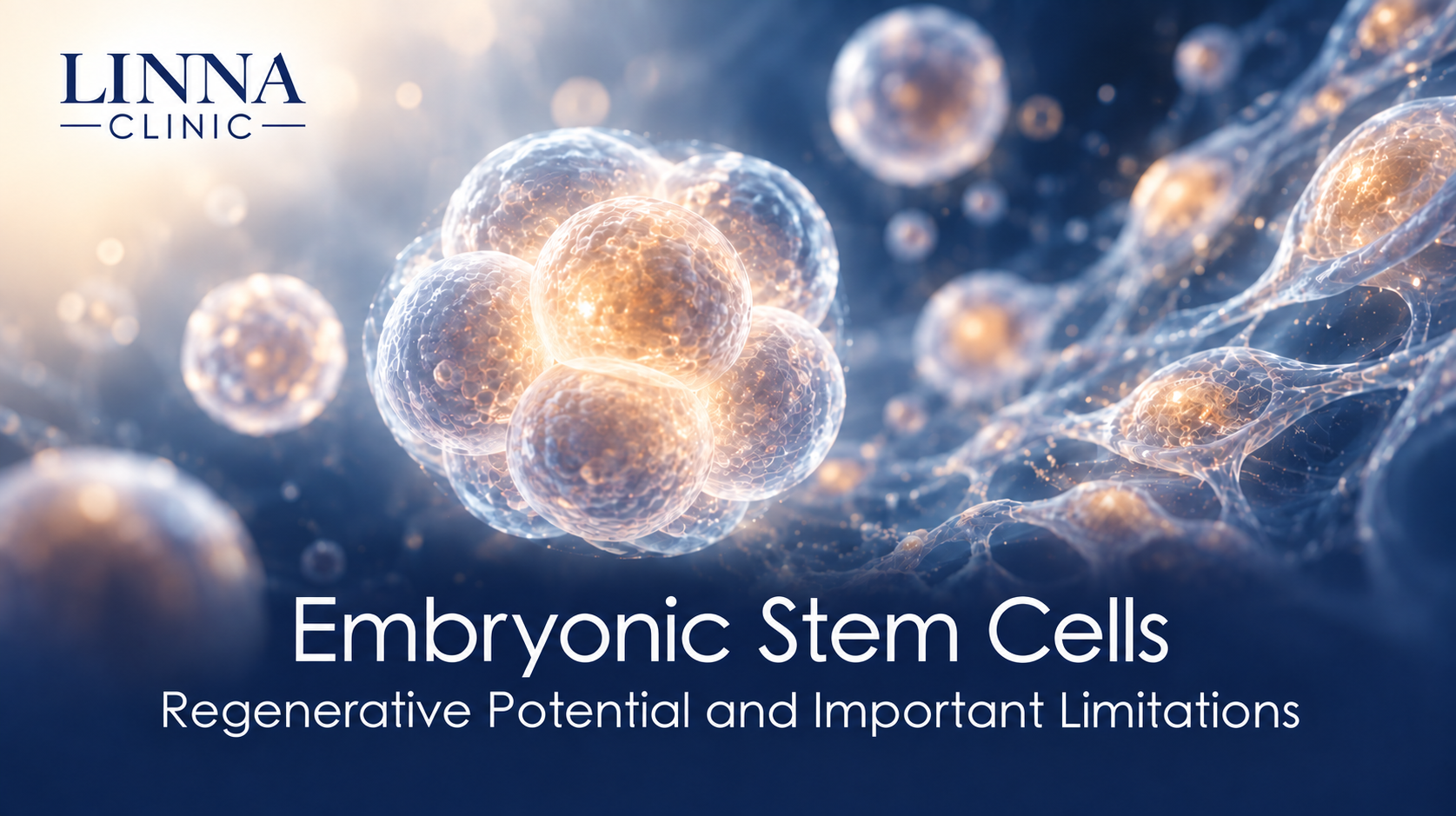
Many people know stem cells as an important medical innovation being studied for treatment and internal regeneration. Stem cells can be obtained from several sources, and each type has different characteristics and potential applications. One widely discussed type is the embryonic stem cell (ESC) because of its high potential: it can continue dividing and can develop into almost any cell type in the human body. For this reason, ESCs are being studied for a wide range of medical applications. Anyone interested in this field should review the information carefully and comprehensively.
完整文章提供泰语版本。
What Are Embryonic Stem Cells?
Embryonic stem cells (ESCs) are stem cells cultured in a laboratory. They are derived from the inner cell mass (ICM) of an early-stage embryo before implantation, during the blastocyst stage, which generally occurs 5–6 days after fertilization. These cells have not yet developed into specialized cells. Under suitable conditions, they can continue to multiply while retaining their stem-cell properties (self-renewal**) and can develop into almost any cell type in the body (pluripotency**), including skin, nerve, muscle, bone, and blood cells, as well as liver, pancreatic, and lung cells.
Origin of Embryonic Stem Cells
After fertilization, the egg begins to divide continuously. A single cell develops into a group of cells before becoming a blastocyst, generally around days 5–6 after fertilization. At this stage, the embryo resembles a fluid-filled structure and consists of two important cell groups:
- Trophectoderm: The outer layer of cells, which develops into extraembryonic tissues and plays a role in attachment to and implantation in the uterine wall.
- Inner Cell Mass (ICM): The group of cells inside the embryo that develops into the tissues and organs of the body.
Embryonic stem cells originate from the ICM. Researchers isolate this group of cells from a blastocyst and culture it in a laboratory under carefully controlled conditions. In general, the embryos used are created through in vitro fertilization (IVF) and are not intended for further reproductive use. Their use requires donor consent and must be conducted in accordance with strict regulatory and ethical requirements.
During culture, researchers control the conditions so that the cells continue to multiply while remaining stem cells rather than immediately developing into specialized cells. This process can establish an embryonic stem cell line for further medical research and development.
Characteristics of Embryonic Stem Cells
Embryonic stem cells have several important characteristics that have attracted interest in medicine and regenerative medicine:
- Continuous multiplication (self-renewal): ESCs can divide to produce large numbers of new stem cells that retain their original properties. Under suitable culture conditions, they do not immediately develop into specialized cells.
- Development into almost any cell type (pluripotency): ESCs can develop into specialized cells derived from all three embryonic germ layers—ectoderm, mesoderm, and endoderm. These include skin, nerve, muscle, bone, and blood cells, as well as liver, pancreatic, and lung cells. This creates potential for replacing cells damaged or lost through disease or injury.
- Controlled differentiation: By providing nutrients and chemical signals, together with carefully controlled culture conditions, researchers can guide ESCs toward target cell types, such as cardiac muscle cells, nerve cells, or insulin-producing pancreatic cells.
How Do Embryonic Stem Cells Work?
After ESCs have been cultured, guided to develop into the desired target cells, and subjected to rigorous quality-control procedures, a physician may administer them to the area requiring regeneration through an appropriate method, such as direct injection or transplantation into tissue. The cells may then act through processes including:
- Adapting to the body’s environment: Transplanted cells adapt to the environment of the target area. However, some cells may not survive and may be eliminated by the body.
- Attaching to or connecting with existing tissue: Some surviving cells may attach to, integrate with, or connect to cells and tissues in the target area. This depends on the cell type and the transplantation site.
- Maturing and performing specialized functions: Surviving cells may continue to adapt and mature inside the body before carrying out functions associated with their cell type. They may help replace lost cells, support existing cells, or contribute to the recovery of tissue function in the target area.
One research example developed human embryonic stem cells (hESCs), line ESI-017, into PC-M perivascular progenitor cells. These cells share certain characteristics and functions with pericytes, which surround blood vessels and help support and maintain vascular stability. When human umbilical vein endothelial cells (HUVECs) were co-cultured with PC-M cells at a ratio of 20:1, PC-M cells helped produce a denser vessel-like network that degraded less and remained stable for up to six days, whereas networks formed from HUVECs alone began to break down after day two.
This study indicates that PC-M cells may help support and improve the stability of vascular endothelial cell networks. However, these findings are still in vitro evidence, and further studies in animals and humans are required (Greenwood-Goodwin et al., 2016).
Physicians should schedule follow-up appointments after treatment to evaluate the body’s response and continuously monitor safety. Because cells developed from ESCs originate outside the recipient’s body, they may trigger an immune response or rejection. In some cases, a physician may consider immunosuppressive medication to reduce rejection and improve the cells’ chances of surviving and functioning in the body. However, outcomes after transplantation may differ between individuals depending on factors such as cell type and purity, the transplantation site and method, the severity of the condition, and each person’s individual response.
Benefits and Potential of Embryonic Stem Cells
Embryonic stem cells have attracted broad interest because of their distinctive properties:
- Potential to develop cells for tissue replacement or regeneration: Because ESCs are pluripotent and can develop into almost any cell type, they are being studied for potential applications in neurological diseases, retinal disorders, diabetes, Parkinson’s disease, and spinal cord injuries. However, many approaches remain in the research and clinical-trial stages.
- A potential source of cells for future cell therapy: Researchers can culture ESCs, multiply them, and develop them into specialized cells such as nerve, cardiac muscle, liver, bone, insulin-producing, and retinal cells. ESCs may therefore become a source of cells for future cell-replacement therapies, but sufficient evidence regarding quality, safety, and clinical outcomes is still required.
- Value in medical research and development: Specialized cells developed from ESCs can be used to study the causes and mechanisms of certain diseases, test medicines, and evaluate the toxicity and safety of various substances in relation to the human body.
How Are Embryonic Stem Cells Different from Stem Cells from Other Sources?
Stem-cell types differ in their source, ability to develop into different cell types, capacity for multiplication, and readiness for medical use. Embryonic stem cells differ from other sources as follows:
- Embryonic Stem Cells: Stem cells derived from a blastocyst, with pluripotent properties. They can multiply continuously and develop into almost any specialized cell type in the body. They have significant potential in medicine and regenerative medicine, but their development and quality must be controlled and evaluated very strictly.
- ES Organ-Specific Cells: Specialized stem cells developed from high-quality human embryonic stem cells (hESCs) and produced under cGMP standards using PureStem® technology and directed differentiation. This process guides cells to become embryonic progenitor cells for specific lineages, such as the brain, nervous system, liver, kidney, muscle, lung, pancreas, thyroid, or heart. Clonal isolation is then used to obtain a homogeneous cell population. Cell-surface markers and gene-expression analysis are used for characterization, resulting in a cell population with consistent properties and reported purity of approximately 95–100%.
- Allogeneic Human Mesenchymal Stromal Cells (MSCs): Cells obtained from young donors and isolated from bone marrow, adipose tissue, umbilical cord tissue, placenta, and certain other tissues. Their advantages include a younger cellular profile and similarity to cells in the human body, which may reduce the risk of cellular abnormalities. However, MSCs have a more limited differentiation capacity than embryonic stem cells, and cell quality depends on the source, donor age, and manufacturing process.
- Organ-Specific MSCs: An approach involving the development of MSC-based stem cells with greater specificity or targeting toward a particular organ, such as cartilage, the heart, liver, or the nervous system, to support treatment and regeneration. This type of stem cell remains a promising area for future medical applications.
- Autologous Stem Cells: Stem cells collected from the patient’s own blood, bone marrow, or adipose tissue. Because they come from the same individual, they are generally compatible with the body and have a lower risk of immune rejection. However, cell quality depends on age and health, and the cells must undergo collection and preparation before use.
Advantages and Limitations of Embryonic Stem Cells
Advantages of Embryonic Stem Cells
- They have the potential to develop into almost any cell type in the body.
- They can multiply in large quantities and continuously when cultured under suitable conditions.
- Their development can be guided toward desired target cells using nutrients, chemical signals, and controlled culture conditions. This supports the development of cell-therapy and regenerative-medicine approaches, although many applications remain under research and clinical investigation.
Limitations of Embryonic Stem Cells
- Development and quality control are complex. Cells must be appropriately differentiated into specialized cells with consistent properties and high purity, requiring experienced personnel and highly standardized laboratories.
- Cells should be selected from a clearly traceable source and cultured and quality-controlled in a properly accredited laboratory to reduce the risks of contamination or poor-quality cells.
- Outcomes may differ between individuals because some cells may not survive, attach, or function together with existing tissue in the same way in every case.
- Some clinical applications of embryonic stem cells are still under investigation. Effectiveness, safety, long-term effects, and ethical considerations require continued evaluation.
Are Embryonic Stem Cells Dangerous?
The use of embryonic stem cells should be considered under the supervision of an experienced specialist and should involve cells from a high-quality, traceable source. The risks may increase when the cells do not meet appropriate standards or when their development is not fully controlled. Potential risks include the formation of teratomas from residual undifferentiated cells, immune rejection, and infection.
For this reason, the use of embryonic stem cells for treatment and regeneration must undergo rigorous evaluation, including laboratory testing, research and clinical trials, and approval from relevant regulatory authorities. It is important to understand that evidence regarding the safety and long-term outcomes of embryonic stem-cell use remains limited, and further research is necessary. This approach cannot replace standard medical treatment, and outcomes may vary according to multiple individual factors.
Conclusion
Embryonic stem cells, or ESCs, are stem cells derived from the inner cell mass of a blastocyst. Their key properties are the ability to multiply continuously and develop into almost any cell type in the body. As a result, they have attracted significant interest in research, medicine, and the development of cell-therapy approaches. However, because this field remains relatively new, further study is needed regarding effectiveness, safety, ethics, and the legal requirements that differ between countries.
LINNA Clinic currently does not offer stem-cell services using cells developed from embryonic stem cells. The clinic’s stem-cell services use mesenchymal stem cells (MSCs), which are not derived from embryos. Those interested may consult LINNA Clinic’s specialist medical team for a detailed health assessment, consideration of the suitability of each stem-cell approach, and an individualized care plan under medical supervision.
Contact us at Tel. 063-609-8888, WhatsApp +66 91 979 9554, or LINE: @linnaclinics
Reference
- Greenwood-Goodwin, M., Yang, J., Hassanipour, M., & Larocca, D. (2016). A novel lineage-restricted, pericyte-like cell line isolated from human embryonic stem cells. Scientific Reports, 6, Article 24403. https://doi.org/10.1038/srep24403
相关疗程

MSC Stemcell for Health Rejuvenation 10 Million Cells
对该项目感兴趣,或需要个性化建议?
LINNA Clinic 团队随时为您推荐最合适的疗程方案。